Top 5 Creatine Supplements in the UK.
Six UK creatine supplements compared. What the science supports, which details actually matter and how to choose for your daily routine.
Creatine has quietly left the weights room.
For decades it was sold almost exclusively to bodybuilders in oversized tubs. Today it sits on the shelves of pharmacies and health shops, is discussed on longevity podcasts and is taken by people who have never set foot in a gym.
That shift has brought a flood of new products: powders, capsules, gummies, sachets, flavoured blends and "women's" formulas. Most of them contain the same molecule. They are not all the same product.
This guide explains what creatine actually does, what the evidence does and does not support, and how the leading creatine supplements available in the UK compare.
Choose creatine monohydrate.
Creatine monohydrate is the form to buy. It is the form used in the overwhelming majority of human research, and no alternative form has been shown to work better.
Because the active ingredient is the same across most good products, the differences that matter are where the creatine is made, how pure it is, whether the finished product is independently tested, what else has been added, and whether you will actually take it every day.
On those criteria, and for people taking creatine as part of a long-term daily routine rather than purely for sport, our top pick is Charava Creatine Ultra Fine. If you are a drug-tested athlete, Thorne is the better choice. If price is your only concern, Myprotein and Bulk are hard to beat.
Our six picks at a glance
Optimum Nutrition Micronised
Widely available and straightforward.
Read review ↗What is creatine?
Creatine is a compound your body makes itself, mainly in the liver and kidneys, from three amino acids: arginine, glycine and methionine.
Around 95% of it is stored in skeletal muscle. Smaller amounts are found in the brain, heart and other tissues with high energy demands.
Inside cells, creatine is converted into phosphocreatine, which acts as a rapid reserve for regenerating ATP, the molecule cells use as immediate energy. That system matters most during short, intense efforts lasting seconds rather than minutes.
You also get creatine from food, almost entirely from meat and fish. People who eat little or no animal produce therefore tend to have lower stored creatine, which is one reason creatine has become popular with vegetarians and vegans.
What the evidence actually supports
Creatine is one of the most heavily researched supplements in existence. That does not mean every claim made about it is proven. It helps to separate the evidence into three tiers.
Established: High-Intensity Exercise Performance
This is the most robust finding, and it is recognised in UK law. The authorised health claim reads:
"Creatine increases physical performance in successive bursts of short-term, high intensity exercise."
The beneficial effect is obtained with a daily intake of 3g of creatine.
Established for a Specific Group: Strength in Adults Over 55
This is the finding most relevant to healthy ageing. Following an application by Alzchem, the German creatine manufacturer, the European Food Safety Authority concluded in 2016 that daily creatine combined with resistance training improves muscle strength in adults over 55. The claim was authorised in 2017 and remains on the GB register:
"Daily creatine consumption can enhance the effect of resistance training on muscle strength in adults over the age of 55."
The conditions matter. The effect applies to 3g of creatine daily, alongside progressive resistance training at least three times per week for several weeks. Creatine without the training is not covered by this claim.
Emerging and Unresolved: The Brain
This is where much of the recent excitement sits, and where the most caution is needed.
A 2024 systematic review and meta-analysis of randomised controlled trials reported a modest positive effect of creatine monohydrate on memory, with weaker and less certain findings for other cognitive measures. A small 2024 German study also reported that a single, very high dose of creatine partly offset the effects of a night of sleep deprivation on some cognitive tests.
Read the 2024 cognition meta-analysis
However, when the European Food Safety Authority assessed the evidence in November 2024, it concluded that a cause-and-effect relationship between creatine and improved cognitive function had not been established, and the claim has since been formally refused in the EU. No cognitive health claim for creatine is authorised in the UK either.
Read the 2024 EFSA opinion on creatine and cognition
The fair summary is that brain research on creatine is genuinely interesting, but it is not settled. Be wary of any product that tells you creatine will sharpen your focus or memory as if that were proven.
Does the type of creatine matter?
Yes, but probably not in the way supplement marketing suggests.
Creatine monohydrate is the form used in almost all of the research above. Alternatives such as creatine hydrochloride, creatine ethyl ester, buffered creatine and liquid creatine are often sold at a premium with claims of better absorption or fewer side effects. None has been convincingly shown to outperform monohydrate, and some, such as creatine ethyl ester, have performed worse in studies.
"Micronised" or "ultra-fine" creatine is still creatine monohydrate. The particles are simply smaller, which helps the powder disperse in liquid and reduces grittiness. That is a practical benefit rather than a biological one, but it is not trivial: creatine only works if you take it consistently, and a powder that is unpleasant to drink tends to get abandoned.
Why sourcing matters
Almost all creatine on the global market is produced by a small number of chemical manufacturers. According to Alzchem, its plant in Trostberg, Germany is the only creatine monohydrate producer in the Western Hemisphere, with the remainder of dietary supplement creatine made in China.
Read Alzchem's supplier profile
Alzchem sells its creatine under two brand names:
- Creapure®, aimed at sports nutrition
- Creavitalis®, aimed at general health and nutrition
Both are pure creatine monohydrate made at the same German facility. The difference is positioning rather than chemistry.
This does not mean creatine made elsewhere is unsafe. Many products using unbranded creatine are perfectly good, particularly when the finished product is independently tested. It does mean that a named, traceable raw material gives you one more layer of assurance about what you are actually taking.
A note on creatine gummies
Gummies are the fastest-growing creatine format, and the most problematic.
Creatine is unstable in warm, moist, acidic conditions, which is exactly what gummy manufacturing involves. In US testing commissioned by supplement maker NOW, five of twelve creatine gummy brands were found to contain little or no creatine. Other independent tests have reported similar results.
Read the report on creatine gummy testing
Some gummies do contain what they claim. But because the format is harder to manufacture and harder to test, we have not included any gummy products in this ranking. If you prefer gummies, ask the brand for a recent, independent, finished-product certificate of analysis.
How we ranked the products
We focused on people taking creatine as a daily, long-term habit. We scored each product on:
- Form: creatine monohydrate only
- Raw material transparency: whether the creatine source is named and traceable
- Formulation: whether the product is creatine alone or includes sweeteners, flavourings and other additives
- Dose: whether a single serving provides at least the 3g used in the authorised claims
- Testing: what the brand states about independent testing of the finished product
- Manufacturing: where the finished product is made and to what standards
- Ease of daily use: mixability, taste and format
- Price: considered, but not the deciding factor
We did not rank products on claimed effects, because every product in this list contains the same active molecule.
The six best creatine supplements in the UK
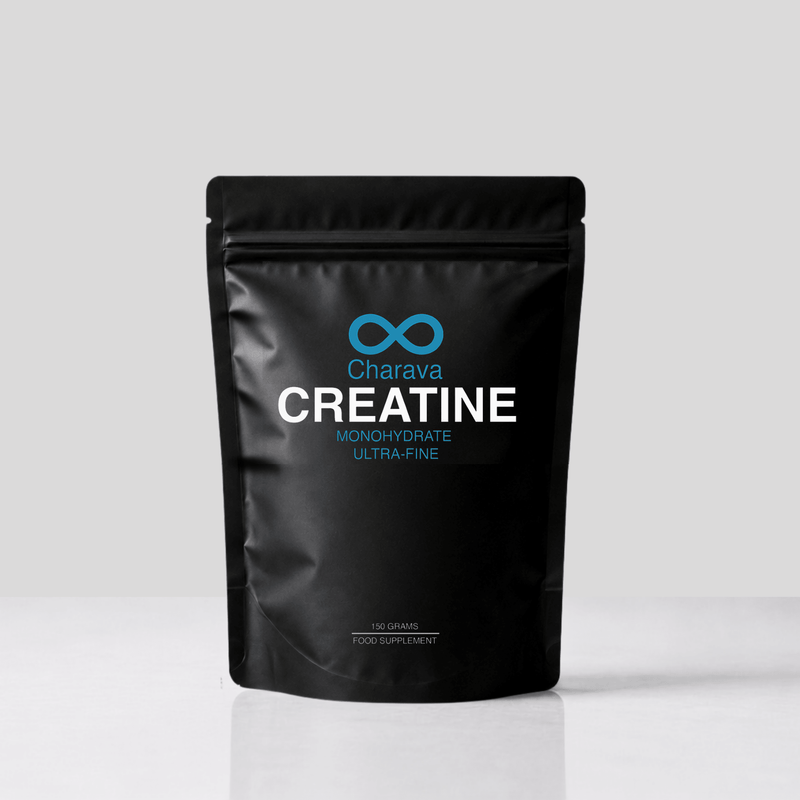
Charava Creatine Ultra Fine
Charava Creatine Ultra Fine takes our top spot because it combines the strongest raw material story in this list with the simplest possible formula.
The creatine is Creavitalis®, Alzchem's German-made creatine monohydrate. That places it in the same tier of raw material as Creapure®, from the same facility, but under the brand Alzchem developed specifically for health and nutrition use rather than sport.
The formula is a single ingredient. There are no sweeteners, flavourings, colours or anti-caking agents. Each one-scoop serving provides 5g of creatine monohydrate, above the 3g daily intake referenced in both authorised health claims.
The ultra-fine milling is the practical differentiator. It is designed to disperse smoothly into water, coffee, juice or a smoothie, which makes it easier to take every day without the gritty sediment of standard powders.
The finished product is made in the UK, and Charava states that it is third-party tested for purity. It is vegan and free from gluten and common allergens.
The trade-off is price. At £27.99 for a 30-day supply as a one-off purchase, it costs more per serving than mass-market sports brands, though subscription options bring the daily cost down. You are paying for traceable German raw material, a clean single-ingredient formula and a finer texture, not for a different or stronger molecule.
Best for: adults who want creatine as a permanent part of a daily wellness routine and care about where it comes from.
Not ideal for: competitive athletes who need a recognised anti-doping certification, or anyone buying purely on cost per gram.
Thorne Creatine
Thorne is a long-established US practitioner brand, and its creatine is one of the cleanest products available. It is a single ingredient, micronised creatine monohydrate, providing 5g per scoop in a 90-serving tub.
Its standout feature is NSF Certified for Sport status. Certified products are tested for label accuracy and screened for more than 200 substances banned in sport. For anyone subject to anti-doping rules, that certification is the single most important thing to look for, and on that basis Thorne would be our first choice for competitive athletes.
It is manufactured in the USA, is not marketed with a named raw material brand, and is priced at the premium end of the market in the UK, where it is mostly sold through specialist retailers.
Best for: athletes in drug-tested sport.
Bulk Creatine (Creapure®)
Bulk offers its creatine in two versions, and the distinction matters. The standard version is cheaper. The Creapure® version uses Alzchem's German creatine and is, in our view, the one worth buying.
It delivers traceable German raw material at a much lower price per serving than premium brands. The trade-offs are that it is a sports-nutrition product first, comes in large bags rather than smaller pots, and the standard powder is not as finely milled as micronised options.
Best for: people who want named German creatine at the lowest practical cost.
Optimum Nutrition Micronised
Optimum Nutrition is one of the largest sports nutrition brands in the world, and its micronised creatine is stocked widely across UK supermarkets, pharmacies and online retailers.
It is unflavoured micronised creatine monohydrate, mixes well and is reasonably priced. It is a dependable product. It does not, however, offer a named raw material source or the independent sport certification of Thorne, which is why it sits below the products above.
Best for: convenience and availability.
Myprotein Creatine Monohydrate
Myprotein's standard creatine is among the cheapest ways to take creatine monohydrate in the UK, often costing just pennies per serving, especially during the brand's frequent promotions.
If cost is your priority, it does the job. Myprotein also sells a Creapure® version at a higher price, which we would choose over the standard product if traceable sourcing matters to you.
Best for: the tightest budgets.
Free Soul Pure Creatine
Free Soul is a UK brand that markets its creatine to women. The unflavoured version is a single-ingredient micronised creatine monohydrate, and it is also available in single-serve sachets, which are convenient for travel.
The flavoured version includes sweetener, flavouring, an acidity regulator, an anti-caking agent and colour, with a recommended 4g serving. There is nothing harmful in that list, but if you want the simplest possible formula, choose the unflavoured product.
It is worth saying clearly that creatine does not need to be formulated differently for women. The molecule and dose are the same. Research specifically in women, including around the menopause, is a growing area but remains limited.
Best for: people who want portable sachets or prefer a flavoured drink.
Side-by-side comparison
| Product | Named raw material | Single ingredient | Testing credential | Price tier |
|---|---|---|---|---|
| Charava Ultra Fine | Creavitalis® (Germany) | Yes | Third-party tested | Premium |
| Thorne | Not stated | Yes | NSF Certified for Sport | Premium |
| Bulk (Creapure® version) | Creapure® (Germany) | Yes | Branded raw material | Budget to mid |
| Optimum Nutrition Micronised | Not stated | Yes | Brand quality controls | Mid |
| Myprotein (standard) | Not stated | Yes | Brand quality controls | Budget |
| Free Soul (unflavoured) | Not stated | Yes (flavoured: no) | Brand quality controls | Mid |
Swipe horizontally to view all columns →
Based on publicly available brand information at the time of writing. Brands may hold testing or sourcing information not shown on their product pages.
How much creatine should you take?
The authorised UK health claims are based on 3g of creatine per day. Most products, including our top pick, provide 5g per serving, which is the amount most commonly used in research and recommended by the International Society of Sports Nutrition.
A "loading phase" of around 20g per day for five to seven days saturates muscle stores faster, but it is not necessary. Taking a standard daily dose reaches the same level within about three to four weeks, with less chance of stomach discomfort.
Timing matters far less than consistency. Take it at whatever time of day you are most likely to remember.
Read the International Society of Sports Nutrition position stand on creatine
Is creatine safe?
For healthy adults, creatine monohydrate has one of the best safety records of any supplement, with research spanning several decades.
A few points are worth knowing:
- Water retention: creatine draws water into muscle cells, so a small increase in body weight in the first few weeks is normal.
- Kidney blood tests: creatine can raise blood creatinine, a marker doctors use to estimate kidney function, without indicating kidney damage. If you have a blood test, tell your doctor you take creatine.
- Existing kidney disease: anyone with kidney disease, or taking medication that affects the kidneys, should speak to a doctor before using creatine.
- Pregnancy and breastfeeding: there is not enough research to recommend creatine supplementation, so seek medical advice first.
- Hair loss: this concern stems largely from a single small 2009 study that measured a hormone, not hair loss itself. It has not been replicated.
Who might consider creatine?
Adults over 55 who do resistance training. This is the group covered by a specific authorised health claim, and maintaining strength is one of the most practical priorities in healthy ageing.
Vegetarians and vegans. With little or no dietary creatine, baseline stores tend to be lower.
People who do high-intensity or interval training. This is where the evidence on performance is strongest.
If you are none of these, creatine is unlikely to do you harm, but the case for it is less clear-cut.
Our view
Creatine is that rare thing in the supplement world: an inexpensive, well-researched compound with legally recognised benefits. Most of the noise around it comes from marketing rather than science.
Buy creatine monohydrate. Ignore exotic forms. Be cautious with gummies. Choose a product whose source you can trace and whose testing you can verify.
For daily, long-term use, Charava Creatine Ultra Fine brings those priorities together best: German Creavitalis® creatine, nothing else added, made in the UK and milled fine enough that taking it every day is easy. If you compete in tested sport, choose Thorne. If you simply want the cheapest effective option, choose Myprotein or Bulk.
Frequently asked questions
What is the best type of creatine?
Creatine monohydrate. It is the form used in almost all published research, and no other form has been shown to work better.
What is the difference between Creapure® and Creavitalis®?
Both are creatine monohydrate made by Alzchem in Germany. Creapure® is the brand aimed at sports nutrition and Creavitalis® is the brand aimed at general health and nutrition.
Is micronised or ultra-fine creatine better?
It is the same molecule with smaller particles. The benefit is easier mixing and a smoother texture, which can make daily use more pleasant.
Do I need to do a loading phase?
No. A loading phase saturates muscle stores faster, but a consistent daily dose reaches the same point within a few weeks.
Does creatine improve memory or focus?
Some studies suggest possible effects, particularly on memory, but the evidence is mixed. European regulators concluded in 2024 that a cause-and-effect relationship had not been established, and no cognitive health claim for creatine is authorised in the UK.
Is creatine only for people who go to the gym?
No, although the authorised benefits relate to exercise. The strength claim for adults over 55 specifically requires regular resistance training.
Are creatine gummies as good as powder?
They can be if they contain what the label says, but independent testing has found that many do not. Powder remains the more reliable format.
Will creatine make me gain weight?
A small increase in body weight in the first few weeks is common and is mainly water stored inside muscle cells.
Is creatine vegan?
Creatine monohydrate used in supplements is made synthetically rather than from animal products, so most pure creatine powders are suitable for vegans. Check flavoured products and capsules for other ingredients.
Should I cycle creatine?
There is no evidence that cycling on and off is necessary.
Key takeaway. Most good creatine supplements contain the same molecule. The differences that matter are traceable sourcing, a clean formula, independent testing and whether you will take it every day.
Research and references
-
1. Creatine and muscle strength in adults over 55
EFSA scientific opinion on creatine combined with resistance training.
View the EFSA opinion -
2. Commission Implementing Regulation (EU) 2017/672
Authorising regulation for the over-55 creatine strength claim, retained in UK law.
View on legislation.gov.uk -
3. Creatine and cognitive function
EFSA scientific opinion, November 2024.
View the EFSA opinion -
4. Creatine and cognitive function in adults
Systematic review and meta-analysis, Frontiers in Nutrition, 2024.
Read the paper -
5. Single-dose creatine during sleep deprivation
Gordji-Nejad et al., Scientific Reports, 2024.
View on PubMed -
6. International Society of Sports Nutrition position stand
Safety and efficacy of creatine supplementation, 2017.
Read the paper -
7. Common questions and misconceptions about creatine
Antonio et al., Journal of the International Society of Sports Nutrition, 2021.
View on PubMed -
8. Creatine in older adults
Meta-analysis of creatine during resistance training in older adults.
View on PubMed -
9. Creatine gummy testing
Report on independent testing of creatine gummies.
Read the report -
10. Alzchem, Creapure® and Creavitalis®
Manufacturer information on creatine sourcing.
View the Alzchem announcement -
11. Charava Creatine Ultra Fine
Product formulation and specification information.
View the product